In March 2023, more than 1,400 people signed an open letter asking the world's AI laboratories to pause. The signatories included some of the most respected names in computer science, Yoshua Bengio, one of the three godfathers of deep learning, and many of the researchers who had spent their careers building the foundations of what AI had become. The letter was serious, precise, and urgent.
Within weeks, it had been largely overtaken by the noise.
The adoption wave did not slow. The announcements kept coming. The vendor promises grew louder. And the warnings, which had come from the very people who understood the technology most deeply, began to feel like a footnote to a story that had already decided its own direction.
I was working as a strategic advisor at the time, and I was watching something I had seen before. Not the technology that was new. But the pattern. The way a hype builds its own momentum. The way the voices promoting the benefits grow louder by the day while the voices urging caution become easier to dismiss. I had watched this happen during the internet bubble. I had watched it happen again in 2008. I recognized the shape of it.
What concerned me most was not the large organizations. They have compliance teams, legal departments, and specialists who will eventually find their way to the governance question. What concerned me was the business leader of a €10 million professional services firm in the Netherlands, or a legal practice in Belgium, or a healthcare organization in Suriname. These are the leaders who felt the pressure most acutely: the fear of falling behind, the competitor who had announced a new AI capability, the client who asked whether they were using the technology yet. And these are the leaders for whom the governance conversation was not being held.
So I started having it. Or trying to.
The results were consistent and frustrating. Every time I tried to name the concern, people heard something I was not saying. They heard, "She is against AI." She wants us to slow down. She does not understand the opportunity. That was not what I was saying at all. But it was what landed.
After enough of those conversations, I stopped trying to communicate better and started asking a different question. Not how do I explain this more clearly? But what am I actually trying to say?
The answer, when I finally named it precisely, had almost nothing to do with AI.
I was trying to talk about what happens to judgment when AI enters the room. About the leaders I had worked with for twenty years: experienced, responsible, thoughtful people who were making AI decisions they could not fully account for. Not because they were careless. Because the conversation around them was moving so fast that nobody was asking who held the authority to decide. The question had been skipped. And once it is skipped at the beginning, it becomes harder to ask as the decisions accumulate.
Seventy-seven percent of small businesses using AI today have no written governance policy. That is not a statistic about negligence. It is a statistic about a conversation that has not yet been had because the dominant narrative is about adoption, efficiency, and competitive advantage, not about who holds the authority to define what the system is permitted to do.
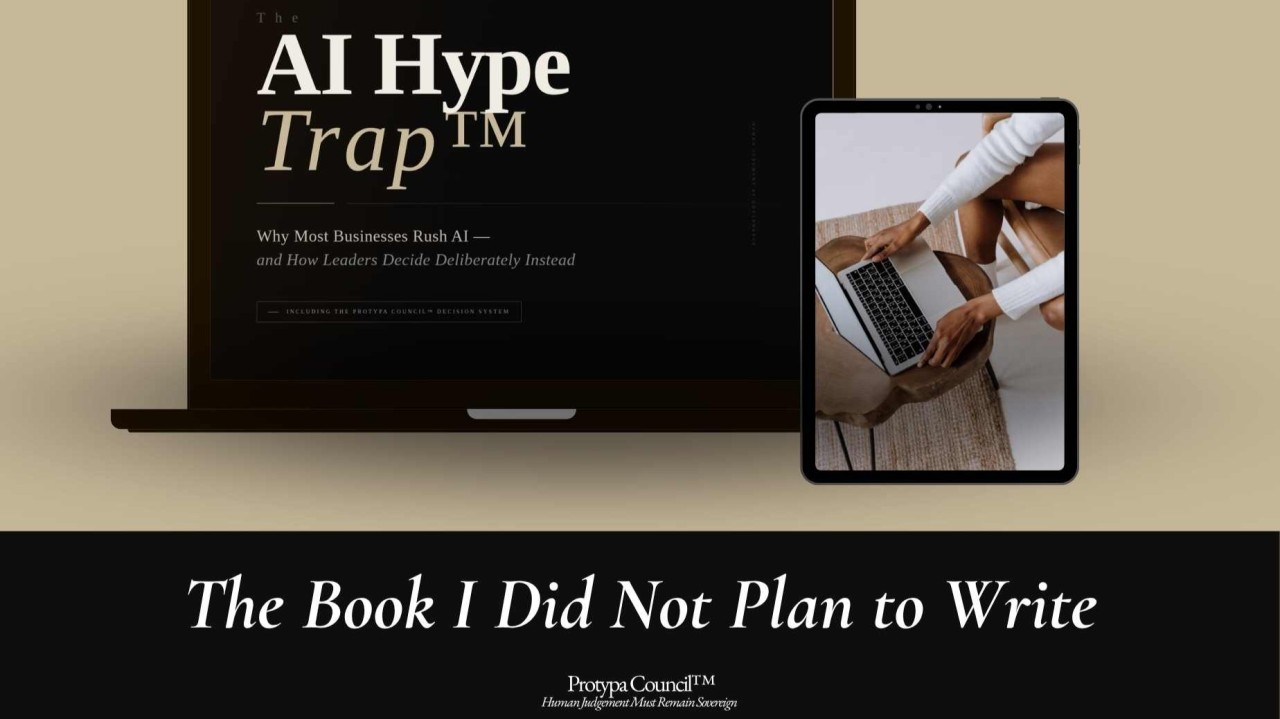
The book that eventually emerged from those failed conversations, The AI Hype Trap™, was not planned. It grew from the discipline of trying to communicate something precisely enough to be understood. And the thing I was trying to communicate, once I had finally named it correctly, was this: the question worth asking is not whether to use AI. It is who decides how, and whether that decision was ever made deliberately.
That is a governance question. It is also a leadership question. And it is the question that most of the AI conversation, for all its noise and urgency, has still not found its way to.
The warnings from 2023 were not wrong. They were simply aimed at the wrong audience. The people who needed to hear them were not in the laboratories or the boardrooms of large technology companies. They were running professional services firms, legal practices, and healthcare organizations, feeling the pressure, hearing the promises, and making decisions without a framework for making them well.
That is who I wrote the book for. And that is the conversation I am still trying to have.
In het Nederlands
De vraag was nooit of we AI moesten gebruiken. De vraag was wie besliste — en of dat bewust gebeurde.
Human judgment must remain sovereign.
First published in The Authority Brief on LinkedIn on 8 May 2026. Read the original or subscribe on LinkedIn ↗