"Our systems are highly secured." "We are following all the legal rules." "Our vendor supplied a system built for our sector." "We always check the data before we send something out." And, more and more often: "We are using a licensed version of ChatGPT, Claude or Copilot."
I hear some version of each of these sentences when AI governance comes up with leaders. Each answers a real concern, and the last can sound as if it answers the others at once. Taken together, they can make AI governance feel settled while one question has not yet been asked.
Over the past two weeks I took these answers one at a time, using a map with five questions in place of the single word "governance." Four of the questions have natural owners: data, security, compliance and technology. The fifth sits above them: who decides what an AI system may do or influence, and can those with final authority exercise it in practice? This issue is about that fifth question, why it cannot be handed to the owners of the other four by default, and why it has to be answered more than once.
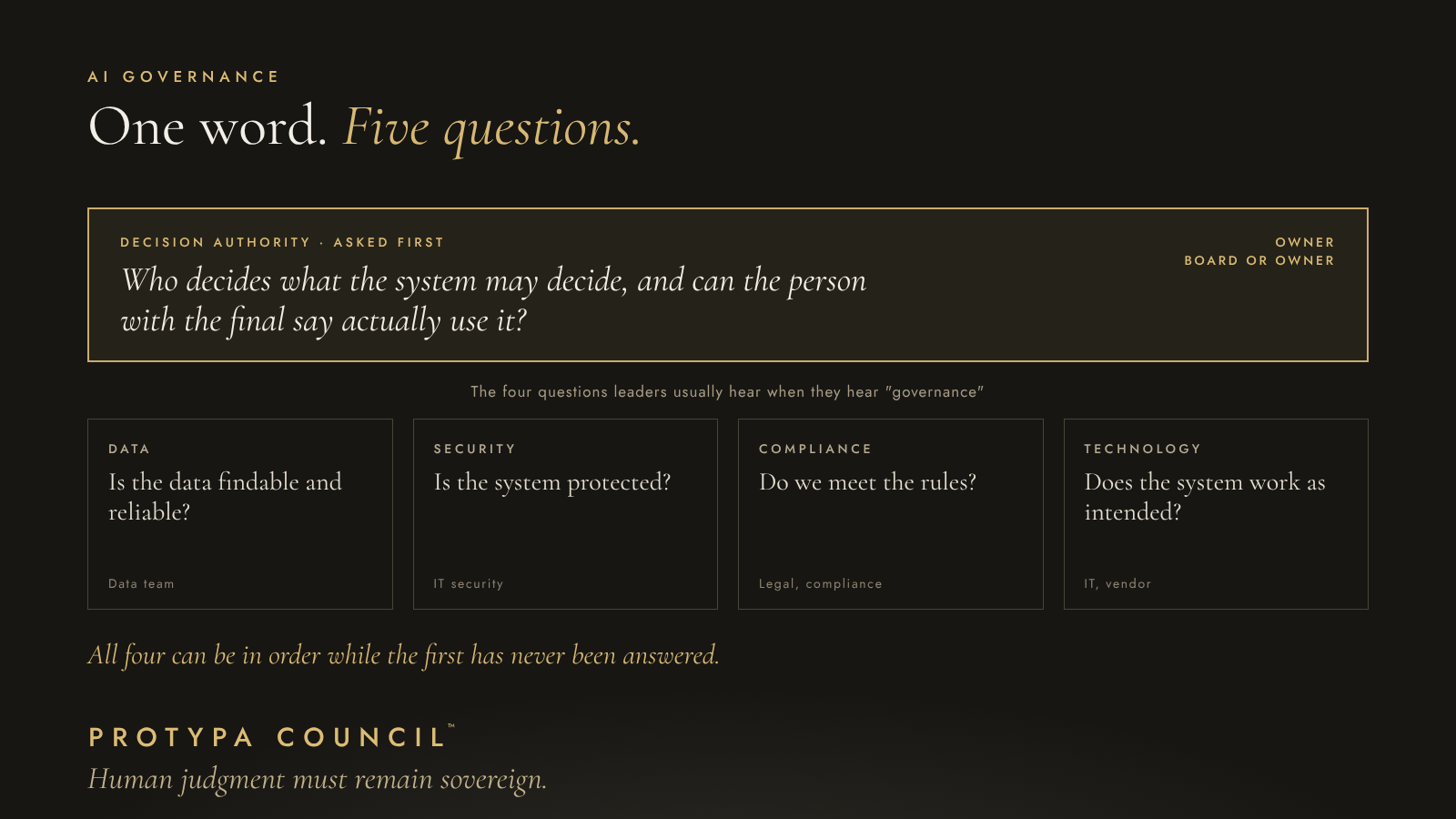
What leaders hear when they hear AI governance
The security services have carried their question into the boardroom. Their September factsheet tells directors that the greatest risk lies with them, asks boards to own the risks and fund the response, and puts the AI an organization uses itself inside cybersecurity policy. That protects the system. It is not designed to decide what the system is authorized to do.
The legal profession has gone furthest. Earlier this month the NOvA published a revised version of its AI recommendations. Final responsibility for each file stays with the lawyer. But the firm is now asked for more than a policy: a register of approved tools together with their permitted and excluded uses, because, as the NOvA puts it, a classification that looks only at the tool is incomplete. The policy has to catch AI functions that arrive through software updates, and the firm is asked to appoint a person responsible for AI, at a larger firm for instance the managing partner or CIO, who approves the policy and the tools. Here the compliance question reaches up towards the fifth.
The Dutch Court of Audit, the Algemene Rekenkamer, showed what a thorough answer to the technology question looks like. In its audit of a UWV risk model, the model's own risks were rated low. The higher risks sat in logging and in how changes were controlled, to the point that the algorithm could be changed unnoticed or without authorization. That is a finding about change controls. It leaves the organization to say which changes need a new decision.
And the AI Monitor Ziekenhuizen 2026 shows where some hospitals have placed the governance itself. In a quarter of the 52 surveyed, AI governance falls under another existing body, such as a data or IT board. The survey does not report what those bodies may decide, and nothing should be read into their names. It does show that the question of mandate travels with the assignment.
Read together, these sources cover different parts of the picture. Only the NOvA's revision reaches into the mandate itself, and even there it asks each firm to make the decisions: which tools, which uses, which person. That is not a gap in their work. It is the boundary of it.
Decision authority: the AI governance question that cannot be delegated by default
The clearest view of that edge comes from a fifth Dutch document. In June, the accountancy bodies NBA and NOREA published practical guidance on applying AI. One example describes an AI tool that proposes ledger codes. Its stated aim is to improve consistency without replacing the existing accounting logic and authorization roles. The tool makes proposals the user can authorize. Then comes one sentence, which in English reads: "After a while, once there is sufficient confidence in the processing, one can choose to process certain parts fully automatically."
The guidance is right not to say who that "one" is; that is for each firm. But the sentence marks a precise moment. Until then, a user authorizes individual proposals. Afterwards, certain transactions may be processed without that individual approval. Authorization has not disappeared. It has moved from each transaction to the rule that defines which transactions may run automatically. What the system may decide has changed, and someone has to set that rule.
Confidence is what the technology question can supply: evidence that the processing works. The choice is something else. Deciding that confidence is now sufficient and that a person may step out of part of the work is an exercise of decision authority. The data team, the controller, IT and the vendor can inform it, and their expertise makes it sound. It does not, by itself, give any of them the mandate to make it.
This is why the fifth question cannot be delegated by default. It can be delegated. A board or owner may decide that a data board, a partner group or a controller holds it for a defined area, and in many organizations that is exactly right. The NOvA's call to appoint a person responsible for AI asks firms to make exactly such a delegation explicit. But a delegation is itself a decision, made by those entitled to make it. It does not happen because a body exists, because a tool was approved, or because confidence has grown. Nor does an existing mandate expand by itself when AI changes the scope of the work; what matters is whether it covers the decision at hand.
The same holds for the answer many organizations now give first. Procuring a licensed version of ChatGPT, Claude or Copilot can be an important organizational decision. It may address contractual, security and access requirements, several of the four questions at once. But procuring the tool does not, by itself, determine which consequential uses are permitted: which drafts may go to a client, which summaries may stand in for the file, which recommendations a person may simply accept. Those are decisions about the work, and the license leaves them where they were. In tomorrow's post I return to that sentence and to why it can feel like more than it is.
In Issue 12 I argued that allocating decision authority has to happen before the system decides anything. "Before" is not a single moment at launch. The question returns at every threshold where what the system may do changes: when a tool approved for research is wanted for client advice, when a model is updated or retrained, when proposals become automatic processing, when governance is handed to an existing board. The NOvA's revision treats two of these explicitly: AI functions added through updates are to be assessed before they are used with client files, and a documented sample may replace full manual review of bulk work, with the client's consent. Some thresholds can be authorized in advance, within conditions someone has set. The rest need a decision before the step, not a reconstruction after it.
Each of those steps also changes what a reviewer can meaningfully check. As Issue 13 argued, having the final say on paper is not the same as being able to use it.
When I wrote that governance has many owners and authority needs one, this is what I meant. Not one person for every AI decision. One clear place where the question is decided for each area of work, known to the people who need it, and returned to when the threshold moves.
How to tell whether AI decision authority has been settled
This issue offers no framework. The five posts each closed on a question, and they come down to one test.
Take one AI-supported workflow. Identify what the system is currently permitted to do, who authorized that boundary, and which changes are already covered by that permission. Then ask who can approve an extension, restrict the use or withdraw the permission when circumstances change.
If those answers are clear and known to the people doing the work, decision authority has a defined place. If four questions send you to the data team, IT security, legal and the vendor, and the fifth sends you nowhere in particular, the next update, renewal or successful pilot is the moment to settle it, while the decision is still a choice.
In het Nederlands
Als bestuurders "AI-governance" horen, horen ze vaak vier vragen: is de data betrouwbaar, is het systeem beveiligd, voldoen we aan de regels, en werkt het zoals bedoeld? Op elk van die vragen bestaan serieuze Nederlandse antwoorden. De Algemene Rekenkamer liet zien hoe een goed werkend model toch "ongemerkt of ongeautoriseerd gewijzigd" kon worden, en de NOvA schrijft in haar herziene aanbevelingen: "Een classificatie die uitsluitend naar de tool kijkt is onvolledig." De vijfde vraag ligt daarboven: wie bepaalt wat een AI-systeem mag doen of beïnvloeden, en kan wie het laatste woord heeft, dat woord ook gebruiken? Die vraag kan worden gedelegeerd, maar niet vanzelf: de delegatie is zelf een besluit van wie daartoe bevoegd is. In de AI-leidraad van NBA en NOREA staat precies het moment waarop het ertoe doet: "Na enige tijd, en nadat er voldoende vertrouwen in de verwerking is, kan men kiezen om bepaalde delen volledig automatisch te verwerken." Vertrouwen kan de techniek leveren; wie die "men" is, bepaalt de organisatie zelf. Die vraag komt terug bij elke drempel, dus kijk naar één werkproces en vraag je af wie bij de volgende drempel beslist, vóórdat die drempel er is.
Human judgment must remain sovereign.
First published in The Authority Brief on LinkedIn on 19 November 2026. Read the original or subscribe on LinkedIn ↗