You have done the work. Somewhere in your organization there is a chart, and on that chart the roles are filled. There is a person, or a committee, accountable for the models that price and screen and draft and decide. There is a name against the authority to approve a system for use, a name against the review of what it produces, a name against the decision to switch it off. You did not leave the governance of your AI to chance. You constituted it. Every seat has a name in it.
That is more than most organizations have done, and it is the reason this issue is written for you rather than about someone else. Because the chart cannot tell you the one thing you most need to know, and neither can the policy, and neither can the committee's terms of reference. A seat with a name in it and a seat with a person in it look identical from the outside. They are drawn the same way, minuted the same way, audited the same way. The difference between them does not appear on any document. It appears only once, at the moment a system reaches a decision that matters, in whether the person whose name is in the seat actually exercised judgment or whether the seat was warm and the machine decided and the name simply signed what arrived.
A seat that is named and not occupied in the act is what this practice calls a hollow seat. It is the failure that comes after constitution, not before it, and it is harder to see precisely because the prior work was done correctly. The authority was given. It was received. And then, in the moment it existed for, it was not used.
The previous issues of this brief argued that a human must be constituted to answer before a system acts and that where no one is, the law reaches backward and assigns the answer to whoever it can find. This is the harder half of that argument, and I have held it back until the rest was in place. Constituting the seat is necessary. It is not the same as occupying it. You can do the first perfectly and still not have the second, and the gap between them is where the real exposure now lives, because it is invisible to everyone who reads the chart.
To see why the gap is so easy to miss, it helps to look at the shape of the thing. Picture the seats not as a list but as a wheel. Around the rim are the roles, the functions a human judgment serves in governing a system: the Final Arbiters who hold ultimate authority, the Stewards who guard what the organization is, the Moral Guardians who deliberate on what belongs and what must not, the Boundary Guardians who protect what must never be handed to a machine, the Custodians who carry the responsibility across time. That rim is one axis. It answers the question, Which function does the human serve?. It is the axis every governance framework already has, and it is the axis your chart is drawn on.
There is a second axis, and almost no framework draws it. It does not run around the rim. It runs down through each seat, and it asks a different question entirely, not which function, but is this seat inhabited or only named? Every seat on the rim can be read twice, once for what it is for and once for whether anyone is actually in it. The first axis is horizontal, the roles laid out side by side. The second is vertical, a line through each role that reads occupied or empty. Your chart shows you the first and hides the second. It shows you five named roles and tells you nothing about whether the judgment those roles exist to hold is being exercised in any of them.
Now the part that matters most because it is where intuition fails. When two of the five seats go hollow, the reflex is to say that governance is two fifths gone and three fifths intact, that the system is mostly still governed, that there is time to fix it. That reflex is wrong, and it is wrong in a way that is worth being precise about. The five roles are not five separate judgments that can be summed and averaged. They are five functions of a single governing judgment, the one thing at the center of the wheel that actually answers for what the system does. The rim distributes that judgment into functions. It does not divide it into fifths. So when seats go hollow, what goes absent is not a fraction of the roles. It is the judgment itself from the center. And a center is not a score. It is either governing or it is not.
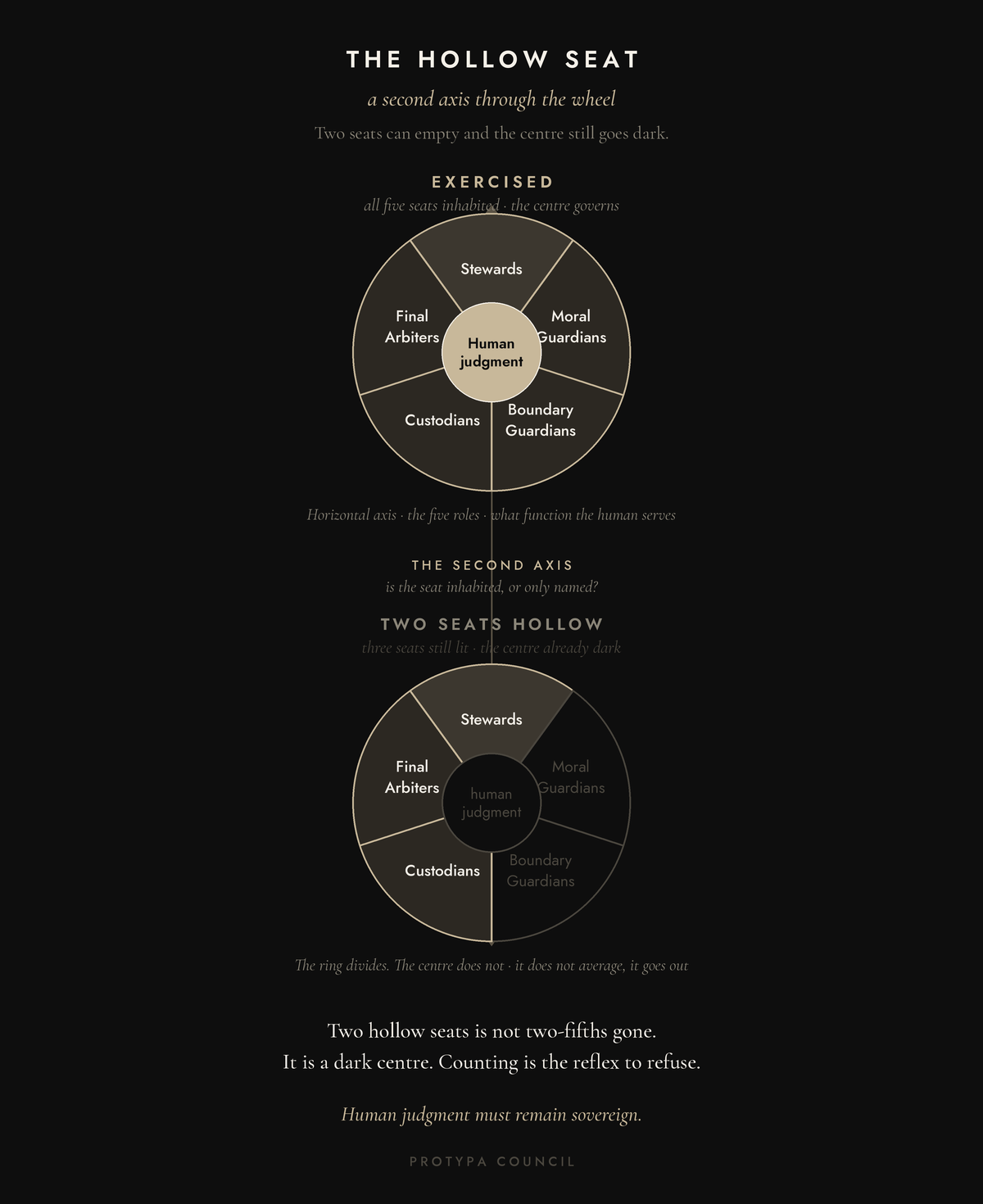
This is why two hollow seats is not two-fifths gone. It is a dark center. A system can show three lit seats out of five, can look on the chart like a governance structure only lightly understaffed, and be, at its center, entirely ungoverned because the judgment that was supposed to answer for it is not being exercised anywhere that counts. The lit seats are what make this survivable to look at. They create the appearance of a mostly working structure while the thing that actually answers has gone dark. The counting reflex, the impulse to tally occupied seats and feel reassured by the majority, is the same reflex that treats governance as a scorecard, a set of boxes mostly ticked. It is the grid in different colors. And it is the reflex to refuse because the center does not average. It goes out.
None of this is abstract, and it has been decided in a court in terms almost purpose-built for the distinction. On 4 April 2023 the Amsterdam Court of Appeal ruled on a group of drivers whose accounts had been deactivated by Uber after an automated system flagged them for fraud. Uber had constituted a seat and constituted it carefully. It told the court that these decisions were not automated at all, that they were taken by at least two members of a named Operational Risk team, acting by unanimous decision, bound by internal protocols that required them to analyze the surrounding facts and confirm or exclude fraud before deactivating anyone. On paper this is exactly the work you have done. A named role, a defined duty, a human required to exercise judgment before the machine's signal became a decision. The seat was constituted.
The court then did the thing the chart cannot do. It asked whether the seat was occupied. It set out the test: for human involvement to be real rather than nominal, the oversight of the decision must be meaningful and not merely a symbolic act, it must be carried out by someone with the authority and the competence to change the decision, and that person must bring all the relevant information into their analysis. Against that test, for three of the four drivers, the court found that what had happened was in no way more than a symbolic act. A note had been made in response to the machine's signal, from an office in Kraków, without the driver ever being heard, without any sign that the person had genuinely weighed the case or could have overturned it. The seat was named. It was staffed. It did not function as judgment. And so the law reclassified the decision as one taken solely by the automated system and held that the drivers had been robo-fired without the protection a human decision would have carried. The consequence was not small: permanent deactivation, lost income, investments in cars and licenses rendered worthless, in at least one case, a taxi license itself put at risk.
For the fourth driver, the same court reached the opposite result, and the reason is the whole of this argument in miniature. In that one case, Uber established, undisputed, that a real conversation had taken place with the driver before the decision. The seat had been occupied. Judgment had been exercised. And so the court held that this decision was not solely automated after all. Same court, same day, same constituted role, the identical Operational Risk team with the identical protocols, and the outcome turned entirely on one thing: whether, in the specific act, the person in the seat exercised the judgment the seat existed to hold or whether the seat was warm and the machine decided. Constitution was constant across all four. Only occupancy differed. And occupancy was everything.
That is the hollow seat, adjudicated. It is also the reason a chart can never reassure you, because Uber's chart would have shown the seat filled in all four cases. The name was in the seat every time. The judgment was in it once.
There is a limit to all of this, and I want to state it plainly, because a practice that overclaims here would be doing the very thing it warns against. Constitution can do a great deal. It can name the answerable person before the system acts. It can define the seat so that occupying it means answering rather than approving, engaging rather than signing so that the role is built to resist becoming symbolic. What constitution cannot do is reach into the person and make them exercise the judgment. It cannot manufacture the nerve to occupy the seat. The reviewer in Kraków was seated, was given the protocol, was given the duty to analyze, and constitution had done everything constitution can do. It could not make them look. And the only force that can compel exercise from the outside is to watch whether it happened, to check each decision for the fingerprints of real judgment. That is monitoring. It is the controls layer, and it comes after, and it is not this one. This practice stands before it, deliberately, and does not colonize it. So the honest account is this. Constitution does the one thing only it can do and only it does: it seats an answerable person before the system acts and defines the seat as one that must answer. Whether that person summons the nerve to answer is theirs to summon. To try to force it from outside is to stop constituting and start monitoring, which is a different layer, later, and belongs to someone else.
Which returns the whole matter to a single question you can ask today, and it is not the question the chart answers. The chart tells you whether the seats are named. It cannot tell you whether they are occupied. So do not ask it. Ask instead about the last consequential decision a system in your organization reached and about the person whose name sits in the seat above it, and find out whether, in that specific act, they exercised judgment they could have used to decide otherwise or whether the seat was warm and the output went out under their name unchanged. If you cannot tell the difference, hold still with that for a moment, because it means the thing you most need to see is the thing your governance is built not to show you. It means the center may already be dark while every seat on the chart still shows a name.
In het Nederlands
Je hebt de stoelen benoemd, en dat is meer dan de meeste organisaties doen, maar een benoemde stoel en een bezette stoel zien er van buiten precies hetzelfde uit; het verschil blijkt pas op het moment dat een systeem een beslissing neemt die ertoe doet. Het Amsterdamse hof liet dat op één dag zien: bij dezelfde, zorgvuldig ingerichte rol werden drie chauffeurs door een louter symbolische menselijke tussenkomst in feite door de machine ontslagen, terwijl bij de vierde, waar wél een echt gesprek plaatsvond, de beslissing juist niet als volledig geautomatiseerd gold.
Twee lege stoelen is dan ook niet twee vijfde weg, maar een donker centrum, want het oordeel in het midden laat zich niet delen of optellen; het is aanwezig of het is het niet.
The Hollow Seat is the first part of The Seat trilogy: The Hollow Seat (Issue 09) · The Unmade Seat (Issue 10) · The Made Seat (Issue 11).
Human judgment must remain sovereign.
First published in The Authority Brief on LinkedIn on 27 August 2026. Read the original or subscribe on LinkedIn ↗