For eleven years, the Dutch Education Executive Agency ran a risk model that no one had ever been asked to defend.
Between 2012 and 2023, DUO used an automated risk profile inside its Controleproces Uitwonende Beurs, the process for checking whether students receiving the higher grant for living away from home were in fact living away from home. The model scored students on three factors, the type of education they were in, the distance between their address and their parents' address, and their age, and sorted them from high risk to low. On the strength of that score, students were selected for a home visit. By the supervisory authority's own estimate, roughly 21,500 students were checked this way over a decade.
What the Dutch data authority found at DUO.
In November 2024 the Autoriteit Persoonsgegevens published its investigation and found the processing unlawful and discriminatory, in breach of the lawfulness principle in the AVG, read together with the prohibition on discrimination in the Charter, the European Convention, and article 1 of the Dutch Constitution. The Minister of Education, Culture and Science, named in law as the controller, had already acknowledged to Parliament that the process produced indirect discrimination against students with a non-European migration background and had offered the cabinet's apologies. This is a regulator's finding rather than a court's judgment, and it carries no final force of law. But it is unrebutted, its controller has conceded the discrimination, and DUO stopped the process in 2023. As a factual account of what happened, it is not in dispute.
The obvious readings are all available, and all of them miss the thing that matters. This was a discrimination case, and it was. It was a data-protection breach, and it was that too. It was an algorithm built on prejudice dressed as common sense, the three risk factors having come, in the developers' own words to the regulator, from experience and common sense, with the frank admission that nothing scientific had been established and no conclusions had been drawn. Each of those readings is true. None of them reaches the failure underneath. And it was, by any technical standard, the governable kind: three factors, a fixed formula, a lookup table, a model simple enough to audit on a single page. Not an opaque system whose outputs no one could have checked, but the plainest kind there is, and it still ran discriminatorily for eleven years, because being auditable is not the same as being audited, and being certifiable is not the same as having anyone constituted to require it.
Why a complete governance apparatus seated no one.
Because the striking thing about DUO is not that it lacked governance. It is how much governance it had. There was a data warehouse. There was a two-phase control process with defined steps. There was a dedicated enforcement and inspection department that made the human selection. There was a formal mandate assigning execution from the Minister down to the agency. And there was reporting, faithfully, every two years, to the ministry's directorate for a decade. The apparatus was complete. What that reporting reported on was cost and yield, the number of visits, the penalties imposed, the money recovered, a careful account of whether the process paid. In ten years of biennial reports, not one asked whether the model itself was justified.
That is the shape of the failure, and it is worth naming precisely, because it is the shape a great deal of AI governance is quietly taking. The field, confronted with the question of who answers when an automated system decides, keeps reaching for the same substitutes, and each of them is visible at DUO. The risk was no one's in particular to hold, so no one held it. The mandate distributed the doing of the work without ever seating the answer for its legitimacy anywhere in particular. The reporting produced an evidence trail, diligent and regular, that documented everything except the one thing. The model was trusted because it felt like common sense. And competent officials operated an output that not one of them had been constituted to answer for. Every one of these reaches the responsibility layer and stops just short of it. None of them constitutes a seat.
This is the distinction the whole case turns on, and it is easy to miss because it hides behind a word everyone uses. The confident answer, across most of the field now, is that responsible use of these systems is a matter of good organizational design, of clear roles, mapped accountabilities, the right structure around the model. By that standard, DUO was well designed. It was mandated, distributed, reported, and staffed. And a decade of that design seated no one who could answer for whether the system was legitimate, because arranging who does the work is a different act from naming who answers for it, and no amount of the first produces the second. A chart can assign every part of a decision and leave no one holding the whole of it. Design distributes. Distributing an answer is precisely how you end with no one who has to give it.
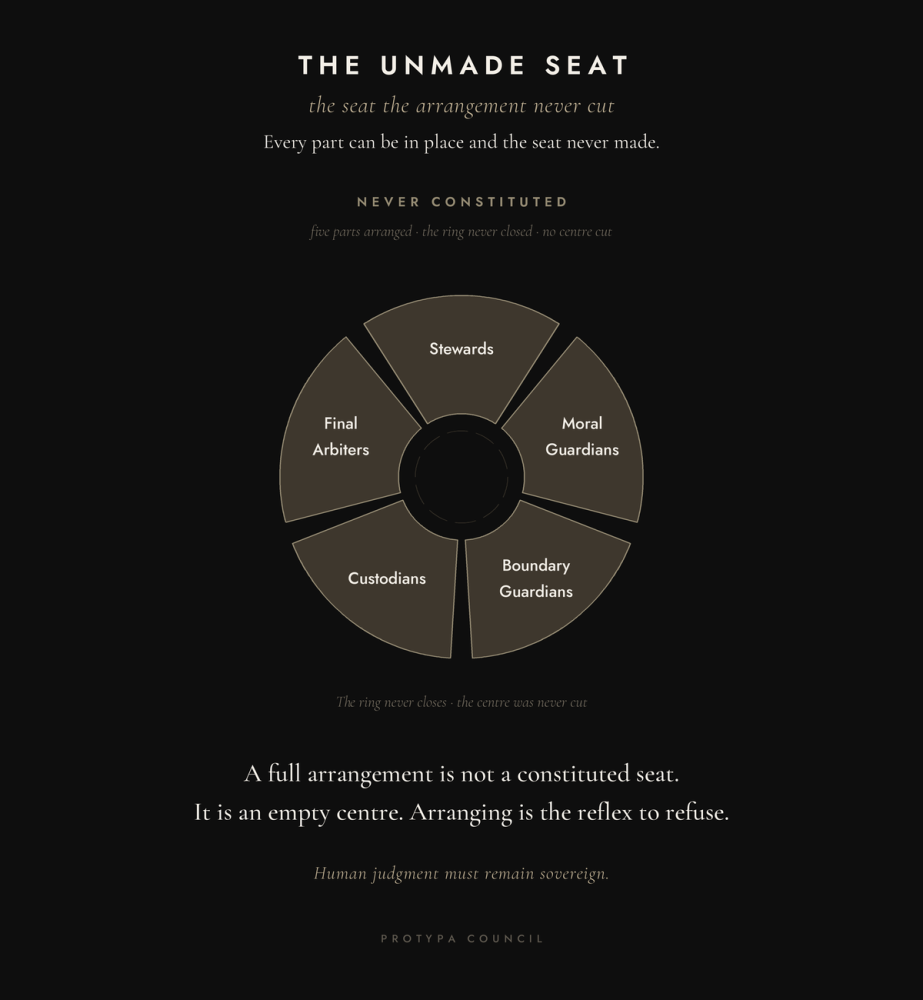
An American appellate judge, writing this year on artificial intelligence in the courts, put the positive form of this better than a regulator can. The judgment, he argues, is the anchor leg, not because it is the strongest part but because it is the one that cannot be delegated. A machine can run the early legs, the research, the sorting, the drafting, but the anchor is where running and responsibility become the same act, where what crosses the line must be carried by someone who can answer for it. Carrying becomes answering. That is the seat. It is not a role in a workflow that can be handed to a clerk, a proposed order, or a machine, and it was exactly the seat DUO never cut.
There is a sharper edge to the DUO case than a seat left unfilled, and it is the edge that makes it worth an issue rather than a paragraph. The seat was not merely unoccupied. It was never conceived. No one at DUO decided that the question of the model's legitimacy did not need an answerer; the question simply never arose as one that belonged to anyone. And that is the deepest version of the failure, because a constituted seat exists precisely for the risk no one enumerated in advance. Its whole reason for being is to answer for what no one thought could occur. So "nobody imagined it could go this way" is not the defense it sounds like. It is the diagnosis. It is the exact account of why the seat was never drawn. Foresight builds controls, for the risks you can name. Constitution answers for the ones you cannot.
A careful reader will reach here for the obvious objection. By 2023 this category of failure, a government fraud algorithm discriminating against people with a migration background, was entirely thinkable in the Netherlands. The country had already lived through it once. The Minister himself asked why DUO had not caught its own version, given that experience. Surely, then, this was a risk that could have been foreseen, and the never-conceived reading collapses. But it does not collapse. It completes. The country had begun to think it, and the institution still did not, and the reason it did not is the whole point. No seat had been constituted inside DUO to carry a newly thinkable risk back into DUO's own system and hold it there as someone's to answer for. The thought was available in the public square. There was no one whose job it was to go and get it. And note what the regulator was careful to establish: its finding of unlawfulness landed on the automated classification itself, with the manual selection by officials appearing only as an amplifier of the bias already built in. The officials operated the model's output. They were never constituted to answer for whether the model deserved to be operated at all.
When the law names the answerer afterward.
Here is what the case leaves you with. When authority is not constituted before a system acts, the law does not leave the question open. It assigns an answerer afterward, by construction. That is precisely what happened at DUO. The Minister was named as the responsible party not because the Minister had been seated in advance to answer for this model, but because the law reaches back, after the harm, and attaches responsibility to whoever held the mandate, by presumption, because no one had been named before. An answerer produced after the fact is not the same as a seat constituted before it. One is the law repairing an absence. The other is an organization taking responsibility as a design decision, ahead of the act, for a risk it cannot yet see.
So the question to carry into your own organization is not whether your use of these systems is well governed, mapped, documented, and staffed. DUO's was. It is narrower and harder. Somewhere in all of it, is there one named person who answers for whether the system itself is legitimate and not merely for whether it runs. If you have to go and look, the seat was never cut.
In het Nederlands
DUO gebruikte elf jaar lang een risicomodel dat niemand ooit had hoeven verdedigen. De apparatuur was compleet: een datawarehouse, een controleproces in twee fasen, een afdeling handhaving, een mandaat, en tweejaarlijkse rapportage aan het ministerie. Wat werd gerapporteerd, ging over kosten en opbrengsten, nooit over de vraag of het model zelf gerechtvaardigd was. Voor die vraag was geen stoel gemaakt. Niet leeg gelaten, maar nooit bedacht, en dat is de diepste vorm van het gebrek, want een belegde stoel bestaat juist voor het risico dat niemand vooraf kon benoemen. Toen het misging, wees de wet alsnog een verantwoordelijke aan, de Minister, achteraf en bij constructie, omdat vooraf niemand was benoemd. Een verantwoordelijke die de wet achteraf toewijst, is niet hetzelfde als een stoel die vooraf is belegd.
De vraag voor uw eigen organisatie is niet of het gebruik netjes is ingericht, gedocumenteerd en bemenst. Het is of er één benoemd persoon is die antwoordt op de vraag of het systeem zelf gerechtvaardigd is, en niet alleen of het draait. Als u dat moet opzoeken, is die stoel nooit gemaakt.
The Unmade Seat is the second part of The Seat trilogy: The Hollow Seat (Issue 09) · The Unmade Seat (Issue 10) · The Made Seat (Issue 11).
Human judgment must remain sovereign.
First published in The Authority Brief on LinkedIn on 10 September 2026. Read the original or subscribe on LinkedIn ↗