In October 2025, KPMG published a report on how to do artificial intelligence well. It was a flagship piece, the latest edition of the firm’s long-running global study of customer experience, and it carried a confident title: Total Experience: Redefining Excellence in the Age of Agentic AI. Eight months later, KPMG took it down.
What happened in between is now a matter of record. A forensic review by the research group GPTZero examined the report’s forty-five citations and found that only five pointed cleanly to real sources. Twenty-eight paired a genuine source with a paraphrased title or a fabricated component, and twelve were too vague to trace at all. Around half of the claims those citations were meant to support appear to be false or misattributed.
The Financial Times reported the findings and took them to the organizations the report named. UBS, Swiss Federal Railways, the NHS in Greater Manchester and Transport for London each said the report’s account of their use of AI was wrong, not accurate, or misleading. KPMG removed the report from its websites and opened an internal review.
It is worth being exact about what this is, because it is not a court ruling or a regulator’s finding, and it carries no force of law. It is a citation audit by an interested party, reported by a national newspaper, with the named firms’ own denials and the firm’s own withdrawal standing behind it. What none of them dispute is the shape of it. A report on how to use agentic AI well had become a demonstration of the failure it was written to warn against. The document was its own case study.
The specifics have a quality of farce. The report described an Emirates chatbot named Sara that talks to passengers and rebooks their flights; Sara is a check-in robot introduced in 2023 that does neither. It cited a 2019 railway press release as evidence of agentic AI at work, half a decade before such systems existed commercially. And it attributed to KPMG’s own research, the claim that fifty-five percent of chief executives rank AI as their top investment priority, when KPMG’s own outlook that same month put the figure at seventy-one. The report shipped in localized editions, including a Belgian one, so it did not stay far from home.
The obvious reading of this is a technology failure. The firm used an AI tool to assemble its sources, the tool invented some of them, and better checking would have caught it. That reading is true as far as it goes, and it is the wrong lesson.
The tool did what these tools do. They produce fluent, plausible text, and when asked to find examples, they will manufacture the ones they cannot reliably retrieve. That is a known property, not a surprise. The surprise, if there is one, is that a report bearing one of the most trusted names in professional services reached the world with evidence that had not been adequately verified.
GPTZero, having read every citation, put it plainly: its researchers suspected that no human at KPMG verified the citations, the claims, or the sources before the report was published. That sentence is the whole matter. It is not a gap in the tooling. It is a missing person. And the tempting fix, a better checker, a validation step, a tighter review, only moves the problem along. A checker checks. A validation step validates. A review reviews. None of them can answer.
Approval is not answerability.
So ask the question the whole episode turns on. Before this report went out under KPMG’s name, who was named to answer for whether it was true.
The firm can point to a great deal. A flagship publication has a process. There were authors, a review, a sign-off and a respected name behind it. All of that is real, and all of it is arrangement. The arrangement produced the report and approved it. What the arrangement did not do, what no arrangement can do, is answer for it.
This is the distinction the whole of this series has been circling, and it is worth stating without softening. Approving a thing and answering for it are different acts. Approval says this may go out. Answering says if this is wrong, it is mine. A signature performs the first. It looks like the second and is not, which is exactly why it holds for as long as nothing goes wrong. Naming an owner, forming a committee, adding a review, applying the logo: each of these arranges responsibility. None of them makes the seat.
The made seat is a plainer thing than any of them. It is a person, named before the system runs, who is constituted to answer for the output and given what answering actually requires: the evidence to see what they are standing behind, the competence to weigh it, and the time to exercise judgment on it. Not to certify that the process was followed, but to be the one for whom the truth of the output is a personal matter. So that if it reaches into the world and proves wrong in a way that matters, that person can say, "This was mine to answer for, and here is why it holds, or here is how we put it right."
That is the seat.
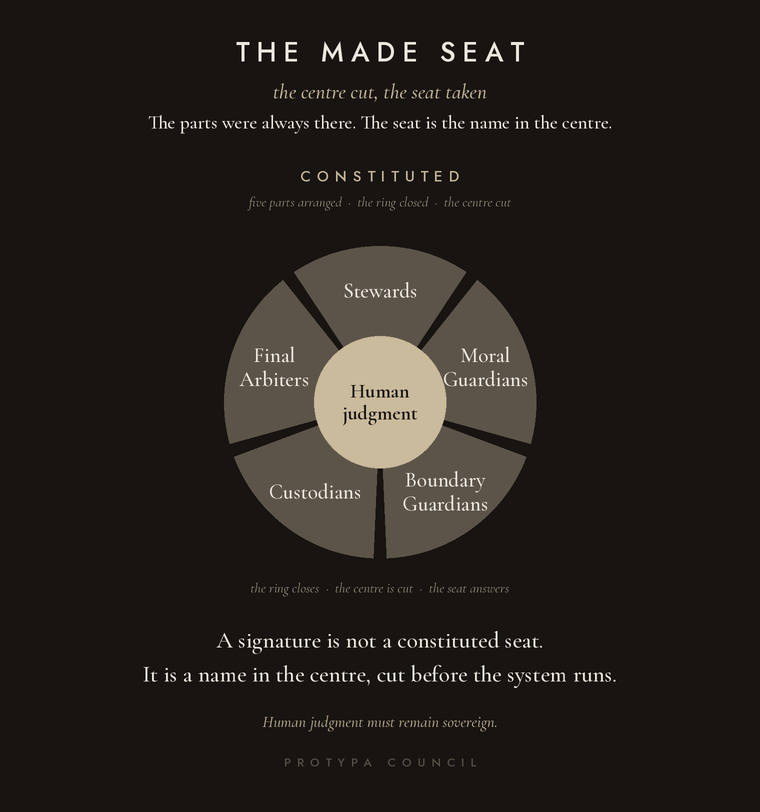
It is also why naming an owner is not enough on its own. An organisation can name someone accountable for an AI-mediated decision and still leave them without the evidence to see what they are answering for, without the competence to weigh it, without the time to exercise any judgment at all. Then the name is there and the seat is not, which is the one thing KPMG’s apparatus, for all its weight, did not contain.
You can hear the objection: a firm of that size obviously has accountability and more process than most organizations will ever build. But process is what it had. It had sign-off and no seat. The review, by the firm’s own account, was a review for positioning, not for truth, which is another way of saying that whether the claims were true was, at the decisive moment, no one’s to answer.
And here is what an unmade seat does every time. Because no one inside KPMG answered for the report, four organizations outside it had to. A global bank, a national railway, a health service and a transit authority found themselves correcting the record about their own operations, answering in public for claims a consultancy had made about them and could not support. That is the mark of the missing seat. When no one is constituted to answer, the answering does not vanish. It falls on whoever stands nearest, and that is never the right person.
Making the seat before the system runs
It is easy to read a story like this as a warning, one more cautionary tale about a firm that got AI wrong. It is not a warning. It is the most useful question you can take into your own organization and it is a small one.
Before your name goes onto the output of any system, a report, a valuation, a diagnosis, a filing, one question decides whether you have a seat or only a signature. Is there a named person who will answer for whether this is true, and were they named before the system ran. If the answer is the process, or the review, or the firm’s good name, then no one is answerable, and your name is doing precisely the work KPMG’s name did, lending authority to an output no person has agreed to stand behind.
The reason this is hopeful, and not another burden, is that the seat costs nothing but the decision to make it. It is not a better model, or more controls, or a larger committee, or a wait for the regulator. It is one person, named in advance, who answers. A firm that has made that seat holds something the fastest adopter without one has already given away: the ability to stand behind its own decisions, in its own name, on the day it is asked to. That is not caution. It is authority, kept.
KPMG’s report went out with a signature and no seat, and the world it reached had to answer in its place. The lesson is not to check your footnotes more carefully. It is to make the seat before the system runs and to know the difference between the two.
In het Nederlands
KPMG trok in 2026 een eigen rapport over agentic AI terug: de bronnen klopten grotendeels niet, en vier genoemde organisaties moesten publiekelijk rechtzetten wat er over hen was beweerd. De makkelijke conclusie is dat de techniek faalde. De echte is dat niemand was aangewezen om vóór publicatie voor de inhoud in te staan. Een handtekening, een review, een merknaam: dat is verantwoordelijkheid beleggen, en dat is niet hetzelfde als de stoel maken. Goedkeuren zegt: dit mag naar buiten. Antwoorden zegt: als dit fout is, is het van mij. De stoel is één persoon, bij naam en vooraf belegd, met de toegang, de kennis en de tijd die het antwoorden vraagt, want je kunt alleen instaan voor wat je hebt kunnen overzien. Wie die stoel maakt, houdt het enige dat de snelste toepasser zonder stoel al begint weg te geven: op de dag dat het ertoe doet, in eigen naam achter de eigen beslissing kunnen staan.
The Made Seat is the third and final part of The Seat trilogy: The Hollow Seat (Issue 09) · The Unmade Seat (Issue 10) · The Made Seat (Issue 11).
Human judgment must remain sovereign.
First published in The Authority Brief on LinkedIn on 24 September 2026. Read the original or subscribe on LinkedIn ↗